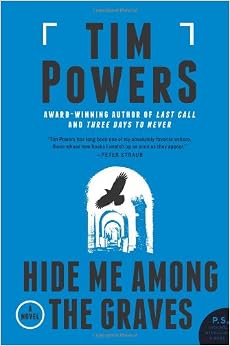
Since the publication of his epic time-travel story
The Anubis Gates in 1983, Tim Powers has
been celebrated for crafting big, bold historical fantasies. His
latest runs true to this form – it's a massive, draughty Gothic
cathedral of a novel, that mixes real life literary figures with
ancient demons, subterranean magic and all manner of sooty, foggy
goings-on.
The action, spread over several decades
in the middle of the 19th century, revolves around poetess
Christina Rossetti, who, as a teenager, accidentally awakens her
vampire uncle, John Polidori. Sub-plots proliferate as others are
drawn into Polidori's morbid sphere of influence, including a
melancholy, cat-loving vet, a reformed prostitute and Christina's
brother, the painter Dante Gabriel Rossetti, whose model-turned-wife
Lizzie is one of the bloodsucker's victims.
Christina makes for a wonderfully
resourceful and self-possessed heroine, despite the fact that she is
at best ambivalent about her uncle – sickened by him, certainly,
but also reluctant to sever all ties with what she perceives as the
inspiration behind her writing. Playing Van Helsing to her Mina is
Edward John Trelawny, a scar-faced ex-pirate and one-time friend of
Lord Byron, who, even in his seventies, is a dab hand at gunplay. And
for comic relief there's the dissolute poet Algernon Swinburne, whose
love of kink and debauchery makes him an ideal recruit to the
vampire's cause.
You don't have to know anything about
any of these historical personages beforehand to enjoy the novel, as
Powers very much makes them his own and introduces them all in a
detailed, leisurely fashion. Throughout, the depth of research is
astonishing. Subtly changing over the course of the story, London
emerges with a remarkable three-dimensional solidity. In contrast,
Polidori is spectral and mysterious, rarely showing his true face and
choosing instead to appear in guises that will be especially
harrowing to the onlooker, past lovers or figments from nightmares.
In addition, Powers conjures up all
kinds of strange but convincing occult lore, such as the notion that
ghosts are attracted to water and the creatures that live in it,
turning the Thames into a repository for the deceased – an idea
that leads to a brilliant set-piece where Christina goes down to the
river and encounters her dead father in the form of a grotesque,
gasping flat-fish. There are also several flesh-creeping descents
into the capital's ancient sewers, the abode of seers, ghouls and
stinging moths. The last section is a little disappointing – the
characters seem to spend a great deal of time chasing, or being
chased by, shadows, only for everything then to be wrapped up in an
overly neat denouement. But you still come away awed by Powers'
narrative verve and phantasmagoric imagination. 9/10